Poker Hand Rankings: All Hands From Best to Worst
Learn the 10 poker hands from Royal Flush to High Card, compare winning combinations, understand kickers and split pots, and check the odds of every hand with practical examples.
A pair of Aces looks strong until an opponent reveals three twos. An Ace-high Straight can lose to a modest Flush. And in Texas Hold’em, two players can show different hole cards yet end up sharing the pot.
Poker hand rankings determine the winner in each case.
Standard high-hand poker recognizes ten commonly listed combinations, from Royal Flush down to High Card. The same ranking system applies to Texas Hold’em, Omaha, and traditional five-card poker, although the rules for selecting your five cards differ between games.
Poker Hand Rankings Chart: Best to Worst
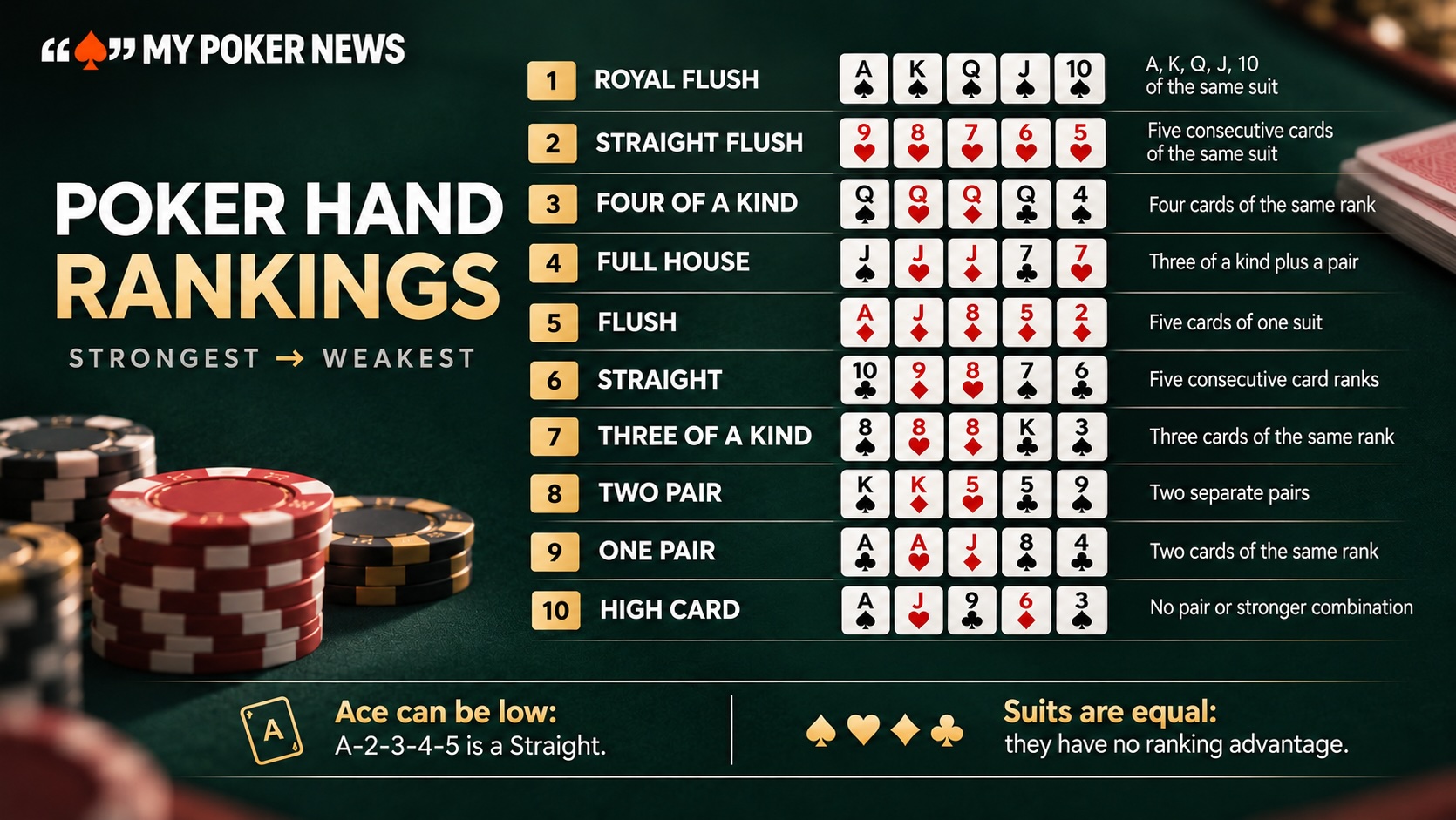
This poker hand rankings chart shows all ten poker hands in descending order. Each example uses five cards from a standard 52-card deck.
| Rank | Poker hand | Five-card example | Definition |
|---|---|---|---|
| 1 | Royal Flush | A♠ K♠ Q♠ J♠ 10♠ | Ace-high Straight Flush |
| 2 | Straight Flush | 9♥ 8♥ 7♥ 6♥ 5♥ | Five consecutive cards of one suit |
| 3 | Four of a Kind | Q♠ Q♥ Q♦ Q♣ 4♠ | Four cards of the same rank |
| 4 | Full House | J♠ J♥ J♦ 7♣ 7♥ | Three matching cards plus a pair |
| 5 | Flush | A♦ J♦ 8♦ 5♦ 2♦ | Five cards of one suit |
| 6 | Straight | 10♣ 9♦ 8♥ 7♠ 6♣ | Five consecutive card ranks |
| 7 | Three of a Kind | 8♠ 8♥ 8♦ K♣ 3♠ | Three cards of the same rank |
| 8 | Two Pair | K♠ K♦ 5♥ 5♣ 9♠ | Two separate pairs |
| 9 | One Pair | A♣ A♥ J♦ 8♠ 4♣ | Two cards of the same rank |
| 10 | High Card | A♠ J♥ 9♣ 6♦ 3♠ | No pair or stronger combination |
Poker Hands Order: Quick Cheat Sheet
STRONGEST
- Royal Flush
- Straight Flush
- Four of a Kind
- Full House
- Flush
- Straight
- Three of a Kind
- Two Pair
- One Pair
- High Card
WEAKEST
The poker hand table establishes the priority of each category. A pair of twos beats an Ace-high hand, while any Flush beats any Straight.
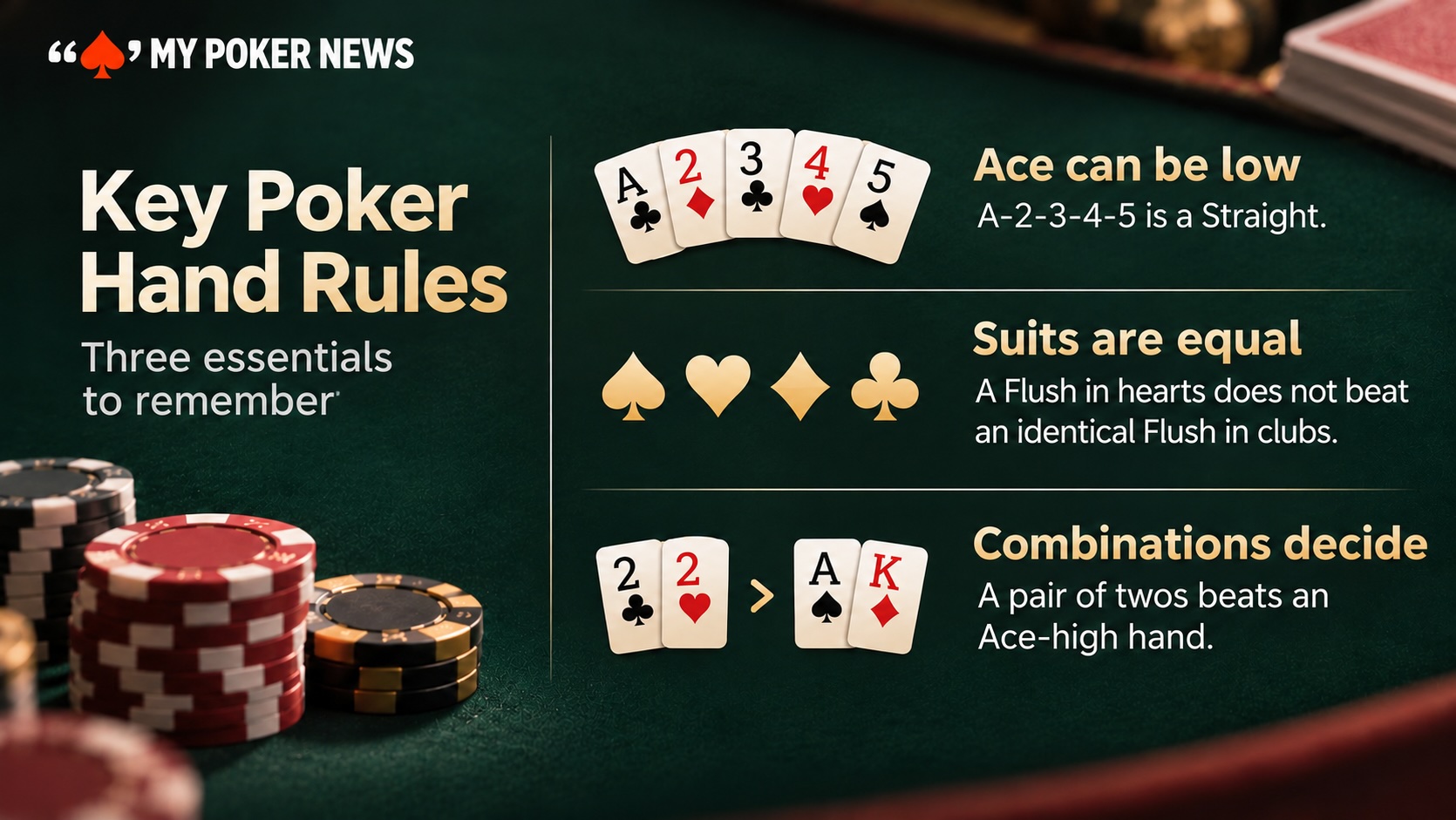
Standard poker card rankings run from Ace down to 2. Ace can also act as the lowest card in an A-2-3-4-5 Straight.
Suits have equal value. A Flush in hearts does not beat an otherwise identical Flush in clubs simply because of its suit.
The order of poker hands is the same in Texas Hold’em, Omaha, and other standard high-hand games.
All 10 Poker Hands Explained
All poker hands have specific requirements. Some depend on matching ranks, others on consecutive cards or a shared suit. The examples also explain terms you’ll hear at the table.
1. Royal Flush
Example: A♥ K♥ Q♥ J♥ 10♥
A Royal Flush consists of Ace, King, Queen, Jack, and 10, all in the same suit.
It is the strongest possible five-card hand. Only four Royal Flush combinations exist in a standard deck, one for each suit.
Technically, a Royal Flush is an Ace-high Straight Flush. Poker charts usually separate it because it represents the absolute top of the rankings.
2. Straight Flush
Example: 8♣ 7♣ 6♣ 5♣ 4♣
A Straight Flush contains five consecutive cards of the same suit.
The highest card determines its strength. A 9-high Straight Flush beats an 8-high Straight Flush, regardless of suit.
Five hearts or five clubs are not enough by themselves. Without consecutive ranks, the combination is an ordinary Flush.
3. Four of a Kind
Example: 10♠ 10♥ 10♦ 10♣ A♦
Four of a Kind, also known as quads, means holding all four cards of one rank.
Four tens beat four nines. The fifth card, called the kicker, matters only when players have identical quads, which can happen when all four matching cards appear on the community board.
4. Full House
Example: K♠ K♥ K♦ 6♣ 6♥
A Full House contains three cards of one rank and two cards of another.
Players describe this example as “Kings full of sixes.” The three matching cards determine the hand’s primary strength.
In full house poker comparisons, Kings full of twos beat Queens full of Aces. The pair is considered only when the three-of-a-kind ranks match.
5. Flush
Example: A♣ Q♣ 9♣ 6♣ 3♣
A Flush contains five cards of the same suit without a consecutive five-card sequence.
In flush poker, the highest card decides first. If two Flushes share the same highest rank, compare the second-highest card, followed by the remaining cards as necessary.
The suit itself never breaks a tie in standard high-hand poker.
6. Straight
Example: J♠ 10♦ 9♣ 8♥ 7♠
A Straight consists of five consecutive card ranks. The suits can be mixed.
A Queen-high Straight beats a Jack-high Straight. The highest possible Straight is 10-J-Q-K-A.
Ace can also count as 1 in A-2-3-4-5, the lowest Straight. It cannot connect King and 2 in a sequence such as Q-K-A-2-3.
7. Three of a Kind
Example: 7♠ 7♥ 7♦ K♣ 2♠
Three of a Kind contains three cards of the same rank and two unrelated cards.
In Texas Hold’em, players distinguish between a set and trips:
- A set forms when your pocket pair matches one card on the board.
- Trips form when you hold one card matching a pair on the board.
Both count as Three of a Kind. The terminology describes how the hand forms, not a difference in ranking.
8. Two Pair
Example: Q♠ Q♦ 4♥ 4♣ A♠
Two Pair contains two matching cards of one rank and two of another, plus a fifth card.
The higher pair determines the initial comparison. Aces and twos beat Kings and Queens because Aces outrank Kings.
When both pairs match, the fifth card decides the winner.
9. One Pair
Example: 9♠ 9♣ A♥ J♦ 5♠
One Pair consists of two cards of the same rank and three other cards of different ranks.
A pair of Kings beats a pair of Queens, even when the Queens are accompanied by an Ace.
When the pairs are equal, the three remaining cards are compared from highest to lowest.
10. High Card
Example: A♦ Q♣ 10♥ 7♠ 3♦
High Card applies when the five cards form no pair, Straight, Flush, or stronger combination.
An Ace-high hand beats a King-high hand. If both players have an Ace, their next-highest cards determine the result.
High Card is the weakest category, but it is also the most common outcome in a random five-card deal.
What Beats What in Poker?
The poker hierarchy determines which category wins before individual card ranks come into play.
An Ace-high Straight loses to a King-high Flush. Four twos beat a Full House made with Aces. A stronger category always takes priority over higher individual cards in a weaker one.
The table shows what hands beat what in poker through five common matchups.
| Hand A | Hand B | Winner | Reason |
|---|---|---|---|
| Three of a Kind: 5♠ 5♥ 5♦ K♣ 2♠ | Two Pair: A♠ A♥ K♦ K♣ 9♥ | Three of a Kind | Three matching cards outrank two pairs |
| Flush: K♥ J♥ 8♥ 5♥ 2♥ | Straight: A♠ K♦ Q♣ J♠ 10♥ | Flush | A Flush ranks above a Straight |
| Full House: 3♠ 3♥ 3♦ 2♣ 2♥ | Flush: A♦ Q♦ J♦ 8♦ 4♦ | Full House | A Full House outranks a Flush |
| Four of a Kind: 2♠ 2♥ 2♦ 2♣ A♣ | Full House: A♠ A♥ A♦ K♣ K♥ | Four of a Kind | Quads outrank a Full House |
| Straight Flush: 6♣ 5♣ 4♣ 3♣ 2♣ | Four of a Kind: K♠ K♥ K♦ K♣ A♠ | Straight Flush | Any Straight Flush beats quads |
Does Two Pair Beat Three of a Kind?
No. Three of a Kind always beats Two Pair.
Even the lowest possible Three of a Kind, three twos, defeats Two Pair made with Aces and Kings.
Does a Flush Beat a Straight in Poker?
Yes. Every Flush beats every Straight.
An Ace-high Straight still loses to a Flush headed by a King or even a lower card.
The value of poker hands depends on their category. Three of a Kind beats Two Pair, even when the pairs are Aces and Kings.
Poker Tie-Breakers: Kickers and Split Pots
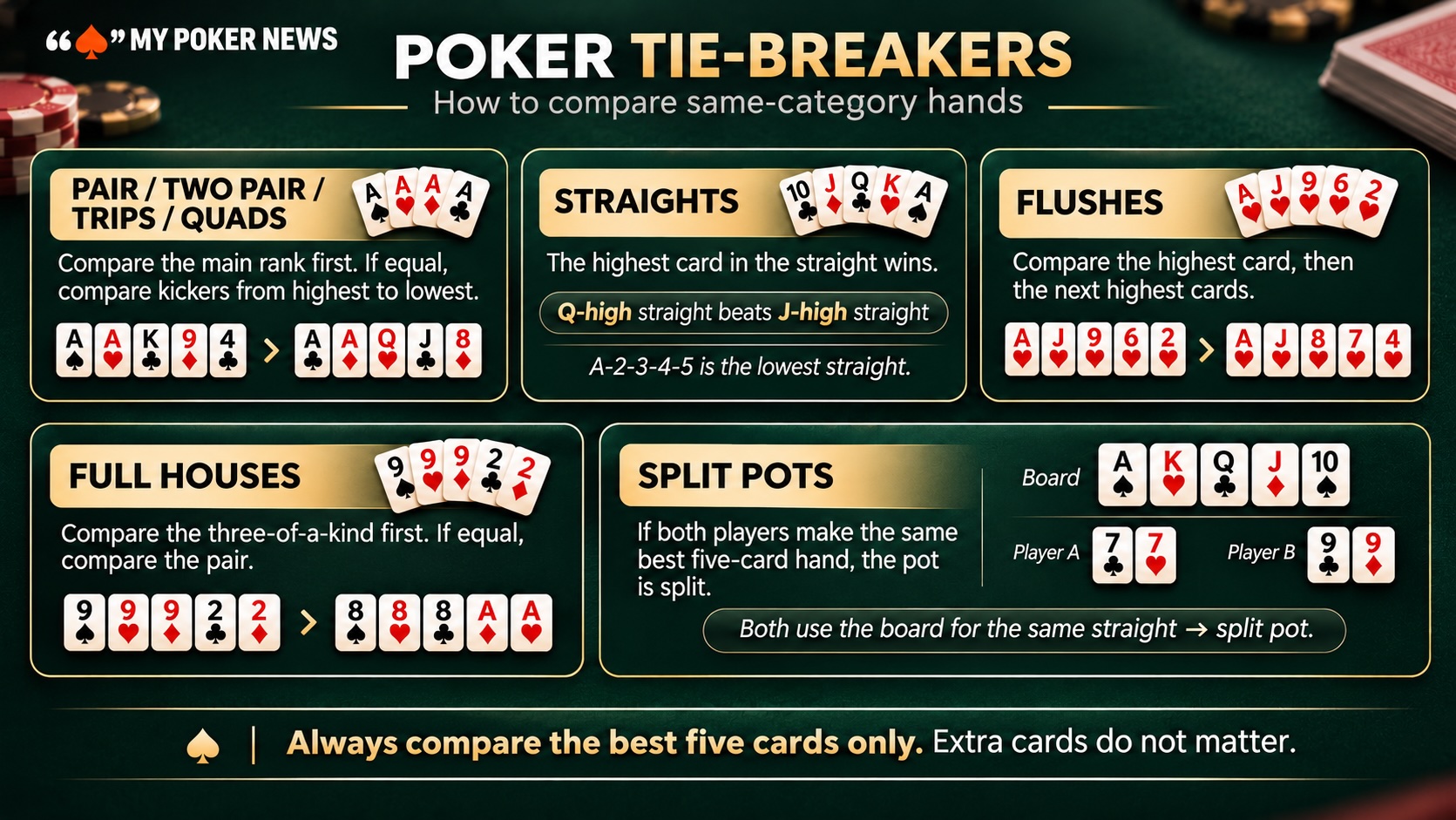
Two players can hold the same category without having equally strong hands. A pair of Kings beats a pair of Queens, while two Ace-high Flushes may require several cards to determine the winner.
Every poker hand comparison comes down to the best five cards each player can make.
What Is a Kicker in Poker?
A kicker is a card outside the main combination that can decide a tie.
Kickers matter with One Pair, Two Pair, Three of a Kind, and Four of a Kind. They are compared only after the ranks forming the main combination are equal.
Example 1: Same pair, different kickers
- Player A: A♠ A♦ K♣ 9♥ 4♠
- Player B: A♥ A♣ Q♠ J♦ 8♣
Both players have a pair of Aces. Player A wins because the King kicker beats the Queen.
Example 2: Identical two pairs
- Player A: K♠ K♦ 8♥ 8♣ A♠
- Player B: K♥ K♣ 8♠ 8♦ Q♠
Both have Kings and eights. Player A’s Ace kicker wins.
These are separate illustrative five-card hands, not cards dealt simultaneously from one deck.
Comparing Straights and Flushes
Straights are ranked by their highest card.
Example 3: Two Straights
- Player A: Q♠ J♦ 10♣ 9♥ 8♠
- Player B: J♣ 10♦ 9♠ 8♥ 7♣
Player A wins with a Queen-high Straight against a Jack-high Straight.
Flushes are compared from the highest card downward.
For example, A♥ J♥ 9♥ 6♥ 2♥ beats A♣ J♣ 8♣ 7♣ 4♣. Both Flushes begin with Ace and Jack, but the nine in the first hand beats the eight in the second.
Comparing Full Houses
With Full Houses, the three-of-a-kind rank is compared first.
A hand containing 9♠ 9♥ 9♦ 2♣ 2♥ beats 8♠ 8♥ 8♦ A♣ A♥. The first hand has three nines, which outrank three eights.
If the three matching cards have equal ranks, compare the pairs. For example, Kings full of tens beat Kings full of nines.
The Best Five Cards and Split Pots
In Texas Hold’em, each player can choose any five cards from their two hole cards and the five community cards.
A sixth or seventh card cannot serve as an additional kicker.
Example 4: Shared Straight on the Board
- Community cards: A♠ K♦ Q♣ J♥ 10♠
- Player A: 7♣ 7♦
- Player B: 9♥ 9♣
Both players have the same Ace-high Straight using all five community cards. Neither pocket pair improves that combination.
The pot is split equally.
When determining the winning hand in poker, only the best five-card combination counts. If both players make identical five-card hands, neither wins outright.
To determine which poker hand wins, compare the best five cards available to each player, including the community cards.
Poker Hand Odds and Probabilities
Some combinations are dramatically harder to make than others. A Royal Flush is exceptionally rare, while High Card and One Pair account for most possible five-card hands.
The probability of different poker hands depends on the number of cards available. The figures below apply to exactly five cards drawn from a standard 52-card deck.
There are 2,598,960 possible five-card combinations, with each combination counted once.
Poker Hand Percentages Chart
| Hand | Possible combinations | Probability | Approximate frequency |
|---|---|---|---|
| Royal Flush | 4 | 0.000154% | 1 in 649,740 |
| Straight Flush, excluding Royal Flush | 36 | 0.001385% | 1 in 72,193 |
| Four of a Kind | 624 | 0.024010% | 1 in 4,165 |
| Full House | 3,744 | 0.144058% | 1 in 694 |
| Flush, excluding Straight Flush | 5,108 | 0.196540% | 1 in 509 |
| Straight, excluding Straight Flush | 10,200 | 0.392465% | 1 in 255 |
| Three of a Kind | 54,912 | 2.112845% | 1 in 47 |
| Two Pair | 123,552 | 4.753902% | 1 in 21 |
| One Pair | 1,098,240 | 42.256903% | 1 in 2.37 |
| High Card | 1,302,540 | 50.117739% | 1 in 2 |
The counts total 2,598,960. Percentages are rounded, so their displayed sum may differ slightly from 100%.
Understanding Poker Hands Statistics
High Card accounts for just over half of all five-card combinations. One Pair represents another 42.26%.
Two Pair appears in approximately one out of every 21 random five-card hands. Three of a Kind occurs about once in 47 hands.
The stronger categories are much less common. A Full House appears roughly once in 694 hands, while Four of a Kind occurs about once in 4,165.
These poker hand odds describe long-run mathematical frequencies. They do not guarantee that a particular combination will appear within a fixed number of deals.
Five-Card Probabilities vs. Texas Hold’em
The table describes five-card hands, not the final outcomes of Texas Hold’em.
In Hold’em, players can use up to seven cards to form their strongest five-card combination. This creates more opportunities to make pairs, Straights, Flushes, and other hands.
There are 133,784,560 possible seven-card combinations in a standard deck. Seven-card calculations classify each combination according to its strongest available five-card hand.
When comparing poker hands and their probabilities, remember that five-card and seven-card calculations describe different outcomes. The odds of receiving a Full House in a five-card deal are not the same as the odds of making one by the river in Hold’em.
Seven-card statistics also describe final hands, not the probability of improving a particular draw from the flop to the river. Those calculations depend on the cards already known.
Poker Hand Rankings FAQ
What Is a Boat in Poker?
A boat is another name for a Full House.
For example, Q♠ Q♥ Q♦ 5♣ 5♥ is a Full House described as “Queens full of fives.”
The term appears frequently in live poker commentary and discussions of individual hands.
What Is Broadway in Poker?
Broadway is the highest possible Straight: 10-J-Q-K-A.
For example, A♠ K♦ Q♣ J♥ 10♠ forms Broadway.
If all five cards share the same suit, the hand becomes a Royal Flush.
What Is a Nut Flush in Poker?
The nut flush is the strongest possible Flush given the community cards.
For example, with K♥ 9♥ 4♥ 2♣ 7♠ on the board, a player holding A♥ Q♥ has the nut flush.
No opponent can make a higher Flush on that board.
The term nuts describes the strongest possible hand in a given situation. It is not a separate category in the poker rankings.
Is Ace 2 3 4 5 a Straight in Poker?
Yes. A-2-3-4-5 is a valid Straight, commonly called a wheel.
For example, A♣ 2♦ 3♠ 4♥ 5♣ forms a five-high Straight.
It is the lowest possible Straight and loses to 2-3-4-5-6.
Ace cannot connect the highest and lowest parts of the ranking in a single sequence. K-A-2-3-4 is not a Straight.
New to the game? Start with our guide on how to play poker.
Articles by this author