Poker Strategy for Beginners: Core Tips and Examples
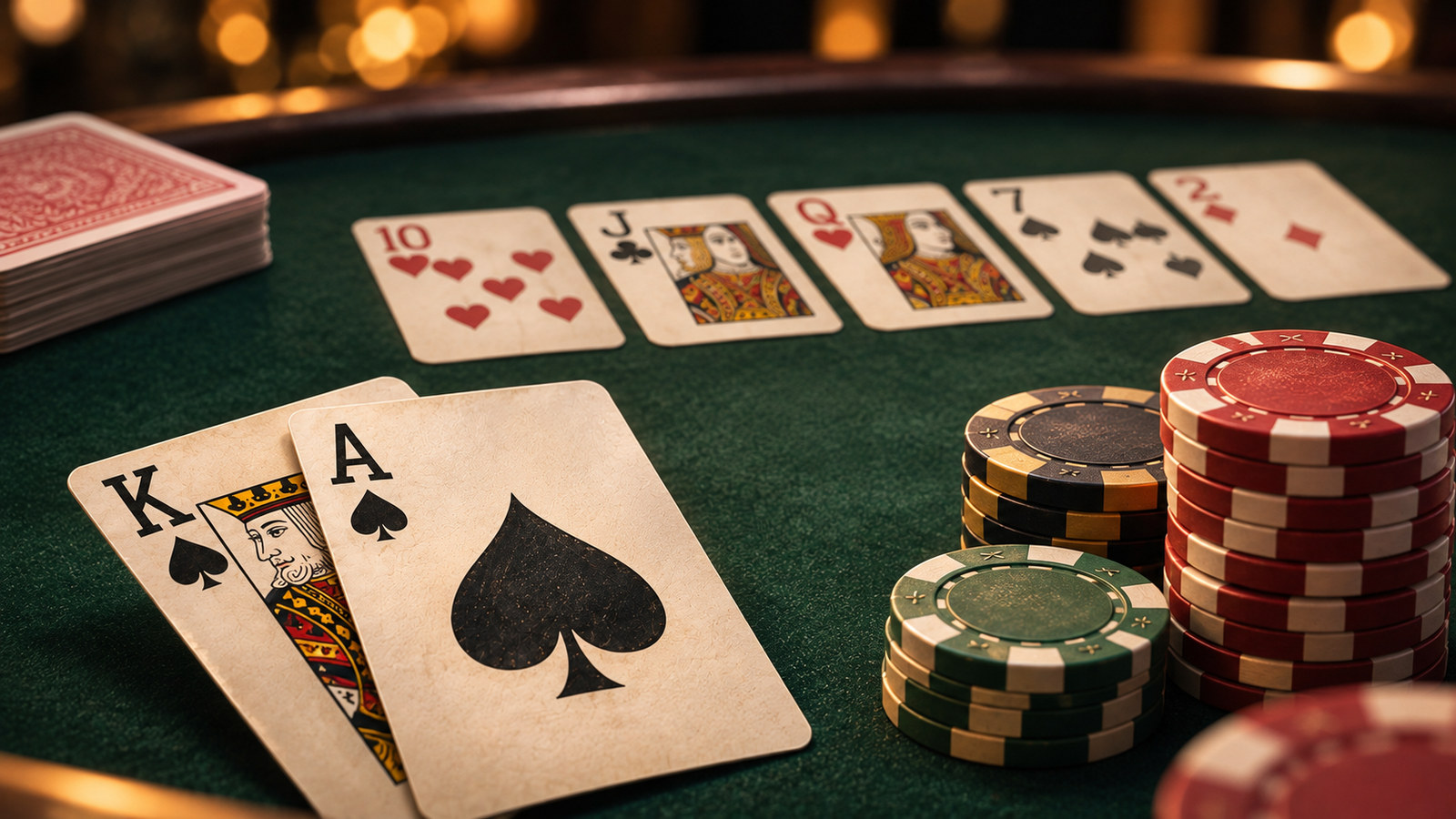
Good poker decisions begin before the flop and continue as each community card changes the hand. This beginner-friendly guide explains starting hands, position, board texture, betting and opponent tendencies, then puts those ideas to work in realistic Texas Hold’em examples.
Poker is not simply about getting good cards. It is about making better decisions than your opponents with the information available at each stage of a hand. A strong poker strategy for beginners starts with choosing which hands to play, understanding position and knowing why you are betting, checking or folding.
This guide focuses on no-limit Texas Hold’em, where players receive two private cards and can use five community cards to make their best five-card hand. If the betting rounds or actions are unfamiliar, review how to play poker before working through the examples below. The aim is not to win every pot; it is to make sensible decisions repeatedly, even when individual results go against you.
Poker Strategy for Beginners: Core Principles
The best basic poker strategy starts with five principles:
- Play selectively. Strong starting hands are easier to navigate than weak, disconnected cards. Folding is a normal part of profitable play, not an admission of defeat.
- Use aggression with a purpose. Betting or raising can win a pot immediately or get called by weaker hands. Calling without a plan often leaves you reacting to someone else.
- Respect position. Acting after an opponent gives you more information. You can usually play more hands from the button than from an early seat.
- Consider your opponents. A bet from a cautious player does not necessarily mean the same thing as a bet from someone who attacks almost every pot.
- Judge decisions, not single results. Variance in poker means a sound play can lose and a poor play can occasionally win. Review the reasoning rather than the outcome alone.
A tight aggressive poker strategy combines the first two ideas: enter fewer pots, but usually raise rather than limp when you have a hand worth opening. Imagine holding A♠ Q♠ on the button after everyone folds. Raising gives you a chance to take the blinds or play a potentially strong hand with position. Merely calling the big blind lets other players see a cheap flop and gives up that immediate opportunity.
Aggression does not mean betting every street. Sound poker tactics include checking marginal hands, folding to credible pressure and changing course when new information undermines a plan.
Preflop Strategy: When to Raise, Call, or Fold
Before the flop, ask: How strong are my cards? Has anyone raised? Where will I act later? How deep are the stacks? These questions matter more than liking a particular hand.
Pocket pairs and combinations such as A-K and A-Q are generally easier to play than weak offsuit cards. Suited or connected cards offer possibilities, but neither feature automatically justifies playing. A hand worth opening on the button may be an easy early-position fold.
| Starting Situation | Sensible Beginner Approach | Main Reason |
|---|---|---|
| Strong hand, no previous raise | Usually raise | Build value and avoid inviting several cheap callers |
| Marginal hand in early position | Usually fold | Many players remain to act and postflop decisions are harder |
| Playable hand on the button, action folds to you | Consider raising | Position and fewer players behind improve your options |
| Weak hand facing a raise | Usually fold | Calling can create an expensive problem on later streets |
For example, K♣ J♦ may look attractive, but facing an opening raise from a careful early-position player, it is often dominated by hands such as A-K, A-J or K-Q. Folding avoids paying to discover that one pair is second best. By contrast, K♣ J♦ may be a reasonable open-raise on the button when everyone has folded, particularly if the blinds seldom fight back.
Calling may be reasonable with a playable hand, an affordable price and a favorable postflop situation. Automatically limping or calling raises with 8♦ 3♣ creates trouble. When opening, use a reasonably consistent raise size rather than advertising hand strength.
Deep stacks offer more scope for speculative hands to improve and win further bets; short stacks leave less room for maneuver. Also distinguish opening a pot from facing someone else’s raise. A hand that can profitably start the action may not be strong enough to call an early-position raiser. Preflop strategy is a framework, not an automatic hand chart.
Postflop Strategy: How to Read the Board
After the flop, ask what hand you have and how strong it is against an opponent’s possible holdings. Absolute strength describes your combination; relative strength factors in the board and opposing range. Even top pair can be comfortable on one flop and vulnerable on another.
Suppose you hold A♠ K♥. On a flop of A♦ 7♣ 2♠, you have top pair with the best kicker on a dry board. Few immediate straight or flush draws are available, so weaker aces and pocket pairs may pay a modest bet. Now keep the same hole cards but change the flop to A♦ T♦ 9♣. You still have top pair with the best kicker, yet two-pair combinations and many draws are possible. A large raise deserves more respect on the second board.
This is board texture: dry boards offer few draws; wet boards offer many. More opponents also increase the chance that someone connects strongly. When a third diamond arrives on the turn, for example, a hand that looked safe on the flop can become a difficult bluff-catcher. The same turn may be harmless on a rainbow board with no realistic flush possibilities.
Distinguish made hands, such as top pair; drawing hands, such as four cards to a flush; and unmade hands with little immediate strength. For the order of completed combinations, consult poker hand rankings.
The turn and river can reverse your outlook. With J♠ T♠ on Q♠ 9♦ 2♠, you have flush and open-ended straight draws, making a call or semi-bluff plausible. If later cards miss, your showdown hand is weak. A spade, eight or king can improve it substantially.
Do not treat a strong flop hand as a promise of victory. Reassess after each card: Which draws arrived? Could your opponent’s calls represent a stronger hand? Would a worse hand still continue against another bet? Thinking one street ahead is useful; refusing to change plans is not.
Poker Betting Strategy: Value Bets, Bluffs, and Pot Control
Most straightforward poker betting strategy comes down to two reasons for wagering: getting called by worse hands or persuading better hands to fold. The first is value betting; the second is bluffing. If neither outcome seems plausible, checking may be preferable to betting automatically.
A value bet makes sense when enough weaker hands can call. Suppose you hold A♥ Q♣ on a board of Q♦ 8♣ 4♠ 2♥ and your opponent has repeatedly called with weaker pairs. A bet can earn chips from Q-J, Q-T or an eight. Against an opponent who continues only with very strong holdings, the same bet might achieve less. The question is not merely “Am I ahead?” but “What worse hands will pay?”
To understand how to bluff effectively in poker, consider your opponent’s ability to fold. Bluffing a habitual caller is rarely appealing. A cautious player who has shown weakness may release a marginal pair, especially when the board and previous actions make your strong-hand story credible. A bluff should represent a believable range, not be a random attempt to win a pot you dislike losing.
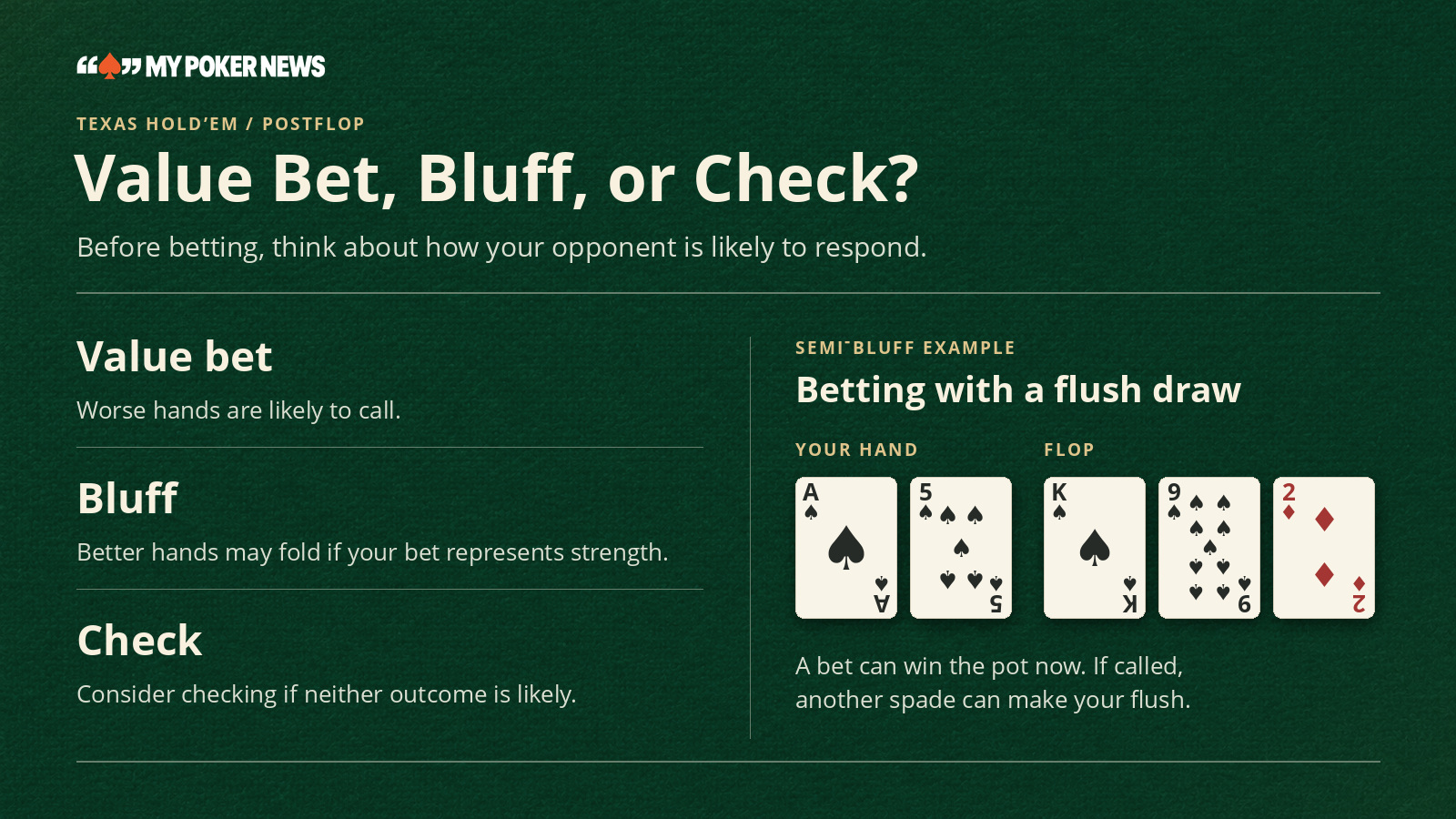
A semi-bluff uses a hand that is currently weak but could improve. With A♠ 5♠ on K♠ 9♠ 2♦, you have a flush draw. Betting may win immediately if your opponent folds, while a call still leaves the possibility of making a flush. That gives the play two potential routes to success, although betting is not mandatory if the opponent rarely folds or the price of a raise would be painful.
A continuation bet, or c-bet, is a bet by the previous street’s aggressor, commonly the preflop raiser betting the flop. A small c-bet on A♦ 7♣ 2♠ can fit a range rich in strong aces. Betting automatically into several callers on a coordinated flop is less convincing.
Bet size shapes the response: smaller bets may retain weaker hands, while larger ones can win more from willing callers or pressure vulnerable holdings. Avoid making your sizing an obvious signal of hand strength. Pot control means checking or calling with marginal hands rather than building an uncomfortable pot.
Reading Opponents and Adjusting Your Poker Strategy
Reading opponents means forming a sensible estimate of their possible hands, not guessing their exact two cards. Use the action so far: who entered the pot, who raised, how large the bets were and whether the player has behaved similarly in previous hands. These clues are useful only in context.
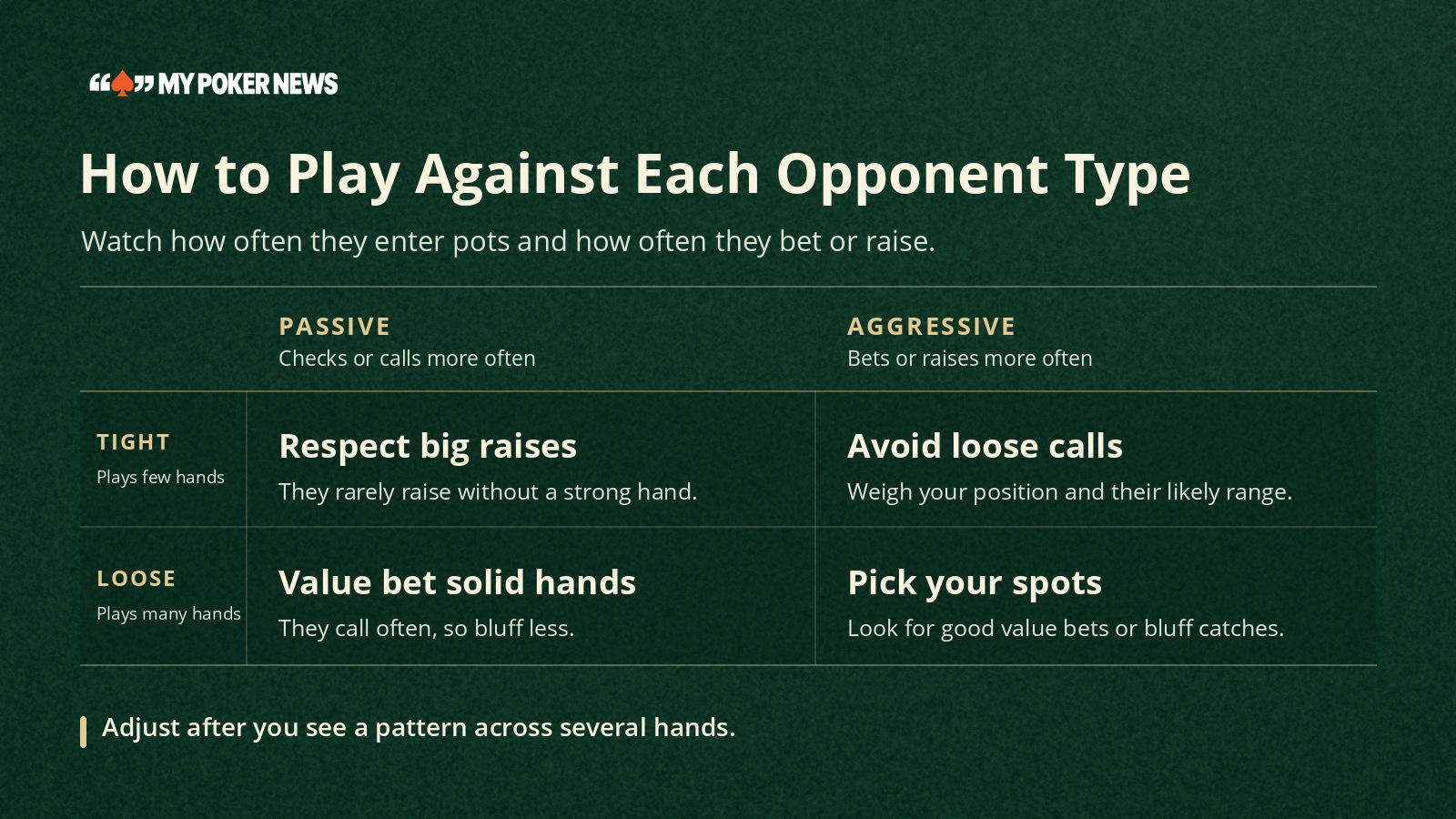
A tight player enters relatively few pots, while a loose player enters many. Passive players prefer checking and calling; aggressive players bet and raise more frequently. A “nit” in poker is an especially cautious player who often avoids marginal situations. These labels describe patterns, not guarantees, and one unusual hand should not define an opponent.
| Opponent Type | Common Pattern | Practical Adjustment |
|---|---|---|
| Tight-passive | Plays few hands, rarely raises without strength | Respect big raises; take small pots when they show weakness |
| Loose-passive | Calls often, raises infrequently | Value bet solid hands; reduce weak bluffs |
| Tight-aggressive | Chooses hands carefully, bets assertively | Avoid casual calls; consider position and credible ranges |
| Loose-aggressive | Enters many pots and applies pressure | Wait for good bluff-catching or value spots; do not chase every confrontation |
Suppose a loose-passive player calls your flop bet and checks the turn. That action could mean a weak pair, a draw or a slow-played strong hand; it does not reveal one precise holding. If this player has called three streets with middle pair before, value betting becomes more attractive. If a normally cautious opponent suddenly makes a large river raise, folding a single pair may be sensible.
Poker tells and poker psychology are not mind-reading tools. A shaky hand, long pause or quick online bet has multiple explanations. Trust repeated action patterns, position and board texture more than one gesture.
Base adjustments on sufficient evidence. Two observed hands prove little; repeated showdowns can justify changing bluff frequency or bet size. Compare what opponents actually showed down with the story their betting told. If a player repeatedly checks strong hands, avoid assuming every check means weakness. Simple notes beat guesswork.
Poker Strategy in Practice: Common Mistakes and Hand Examples
These three hands show how position, board texture and opponent tendencies change the best available choice.
Hand Example 1: Folding a Tempting Starting Hand
You hold A♣ 9♦ in middle position at a nine-handed table. A disciplined player under the gun raises to three big blinds; effective stacks are 80 big blinds. Folding is the clearest beginner choice: A-9 offsuit is often dominated by stronger aces in an early-position range, and calling gives up initiative.
Even after flopping an ace, you may lose to A-J or A-Q. The mistake is treating any ace as too good to fold, without considering the opponent’s range.
Hand Example 2: Playing Top Pair on Two Flops
You raise on the button with A♠ K♥, and the big blind calls. The flop pot is 12 big blinds. On A♦ 7♣ 2♠, top pair with top kicker is strong. After your opponent checks, a four-big-blind value bet may be called by weaker aces or pairs.
On A♦ T♦ 9♣, the same hand faces two-pair combinations and strong draws. Betting remains possible, but a large check-raise from a cautious opponent is more alarming. Do not mistake top pair for an obligation to play a huge pot.
Hand Example 3: Value Bet, Bluff, or Check?
On the button, you reach the river heads-up against someone who calls often with weak pairs. The board is K♣ 8♦ 4♥ 2♠ 2♦; the pot is 30 big blinds, and your opponent checks. With K♥ Q♠, a 10–15-big-blind value bet can attract calls from worse kings or eights. With A♣ J♠, checking is better than bluffing a player unlikely to fold a pair.
Against a tight opponent who has repeatedly folded to river bets, bluffing A♣ J♠ becomes more plausible if your earlier actions represent strength. A bet of 20 big blinds puts more pressure on a marginal pair but risks more chips if called. It is an option, not an obligation: checking remains sensible if the story is unconvincing. Choose bets based on a likely response, not a wish.
Common poker mistakes include playing too many hands, calling without a plan, bluffing habitual callers and failing to value bet strong holdings. If worse hands can call, betting is how you earn extra chips.
Tilt in poker leads to chasing losses, frustrated calls and pointless bluffs. Variance in poker means good decisions can still lose individual pots. Set limits, stop when emotions affect decisions and never raise stakes to recover losses. Judge the choice with the information available then, not the final result.
Before the next decision, use this short checklist:
- What is my hand’s strength against the opponent’s likely range?
- Am I in position, and what has the previous action told me?
- Is the board dry or draw-heavy, and what changed on this street?
- If I bet, which worse hands call or which better hands fold?
- Does the bet size fit my purpose and the effective stacks?
- Am I following a plan, or reacting to frustration and the last pot?
These poker tips cannot guarantee wins. Select hands carefully, reassess the board, bet for a reason and review decisions independently of results. That is a reliable foundation for a beginner poker strategy.
Articles by this author